


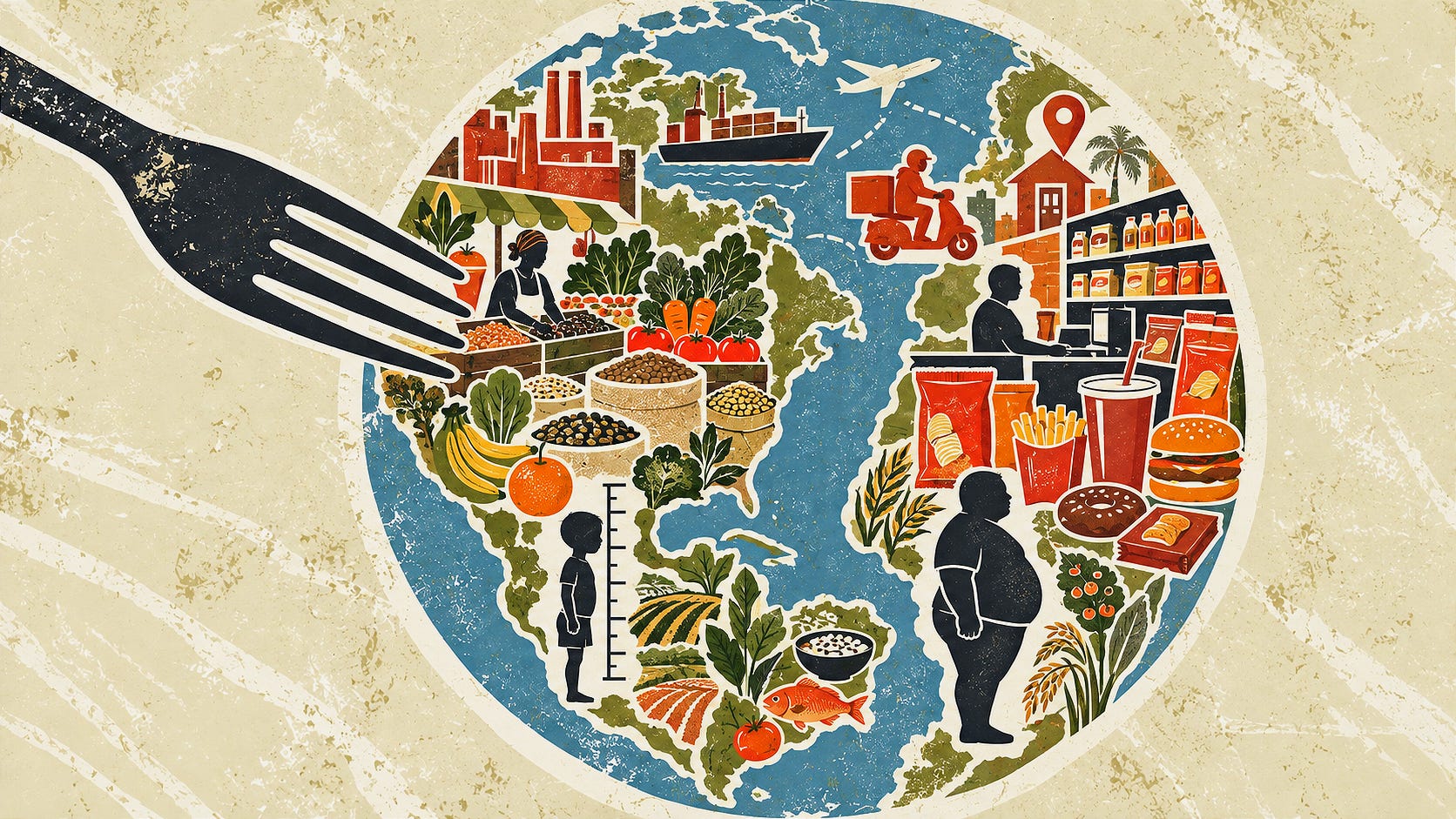
A child can be stunted in a household where an adult is overweight. A country can have supermarkets full of food and still have persistent malnutrition. That sounds contradictory only if malnutrition is understood mainly as too little food.
Nutrition researchers have documented this for decades. In Indonesia, underweight children and overweight adults have been found in the same households. South Africa shows the same pattern: persistent child stunting alongside rising overweight and obesity.
The pattern is global. Across much of Africa, Asia and Latin America, countries now carry overlapping burdens of child stunting, anaemia in women and adult overweight. What looks like scarcity in one body and excess in another can coexist within the same food system. The old thinking of “too little” and “too much” starts to look increasingly inadequate.
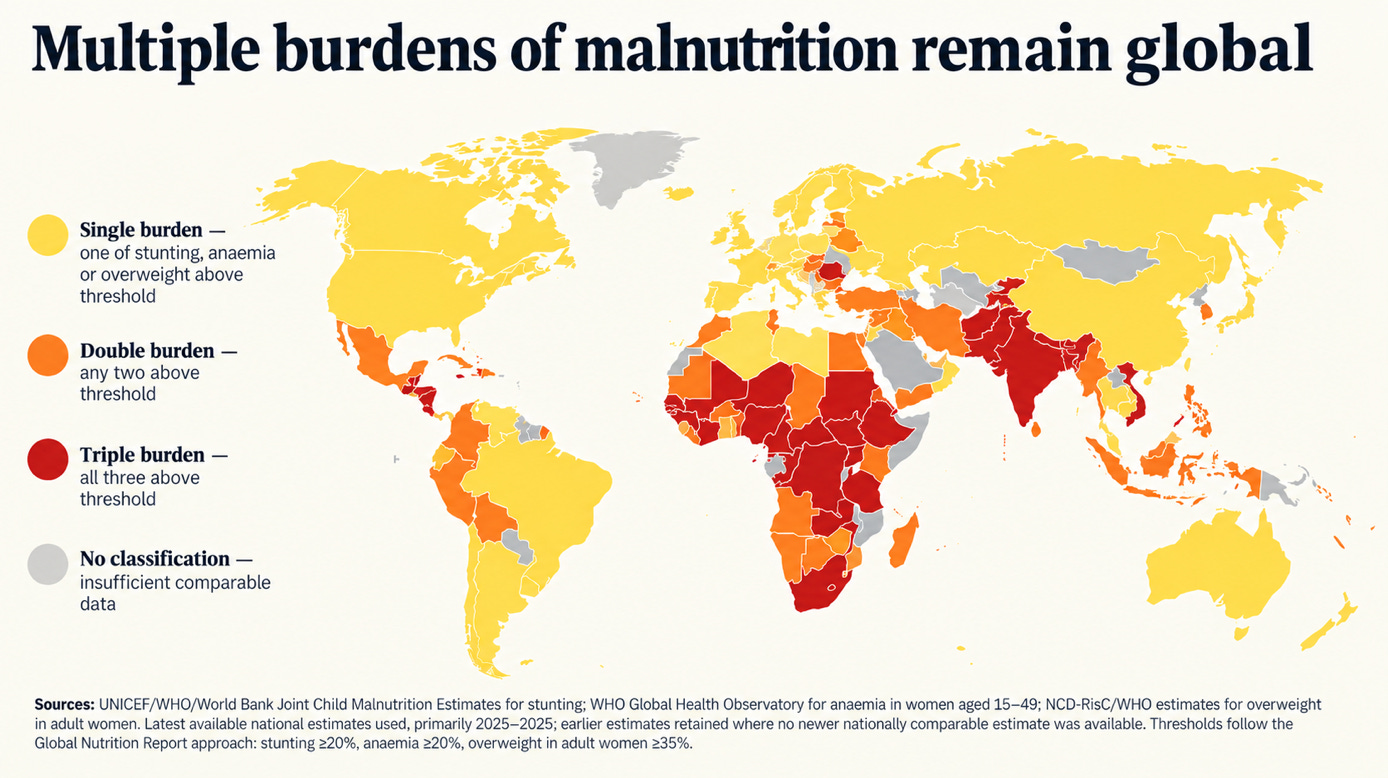
The latest NCD Risk Factor Collaboration analysis assembled 4,050 studies involving 232 million people. It shows how far the nutritional landscape has shifted: while childhood and adolescent obesity have plateaued in many high-income countries, they continue to accelerate across much of Asia, Africa and Latin America.
So why does abundance of food not resolve malnutrition?
Undernutrition is not simply the biological consequence of an empty plate. A child may consume enough calories but too little protein, micronutrients or dietary diversity. Poor maternal nutrition, repeated infections, unsafe water and inadequate sanitation can all compromise growth. Poverty shapes not only how much food reaches a household, but what kind, who eats it and when. WHO’s conceptual framework on childhood stunting places these factors within a wider system of health, education, food, water and sanitation.
South Africa is a telling example. The country produces enough food at national level, yet millions still experience hunger and child malnutrition persists. This contradiction helped prompt the South African Human Rights Commission to launch a national inquiry into the food system.
At the same time, the food environment changes. Cheap calories become plentiful much faster than nutritious diets become universal. Energy-dense, nutrient-poor foods become easier to buy, store, market and consume. The result is not a neat transition from undernutrition to obesity, but an overlap of both.
That is why abundance needs qualification. Abundance of what?
Indonesia is again a case in point. The Food and Agriculture Organization of the United Nations (FAO) estimated in 2025 that a healthy diet was unaffordable for 43.5% of Indonesians, roughly 123 million people. Yet a 2026 food policy study approached affordability differently. Using the least expensive locally available foods, the authors found that actual household food expenditure was theoretically sufficient to meet national dietary guidelines for more than 98% of Indonesians. Actual diets, however, remained far from that healthy basket. Almost all households ate substantial convenience foods and too little fruit, vegetables, legumes, nuts and seeds.
They are not competing answers. But taken together they say something important: price matters enormously, but it is not the whole food environment. Convenience, availability, advertising, retail structures, taste, aspiration and what children see others consuming all matter. So does what sits beside the checkout and what a delivery platform puts first on the screen.
Markets do not simply offer preferences back to us. They participate in making them.
From the perspective of conventional development, the nutrition transition looks odd. Economic growth expands calories and food systems make food cheaper, portable and extraordinarily convenient. But a system can become extremely good at supplying energy while remaining poor at reliably supplying nutrition.
A packet of biscuits can solve an immediate calorie deficit without solving malnutrition. An overweight child can still consume a nutritionally inadequate diet. Obesity is not evidence that malnutrition has been defeated. It can be another way in which a failing food environment produces malnutrition.
WHO recognised this connection years ago in its “double-duty” nutrition agenda: undernutrition, micronutrient deficiencies, overweight and diet-related diseases share enough upstream drivers that separate programmes miss opportunities for common action. Food systems, environments, socioeconomic conditions and early-life nutrition are connected in ways that conventional programmes usually split apart.
And politics still separates them. When the problem is too little nutrition, structural intervention seems natural. Governments fund maternal and child nutrition programmes, fortify foods, provide school meals, improve water and sanitation, and subsidise access.
When the problem becomes obesity, responsibility shifts towards the individual. Read the label. Exercise. Make better choices. But consumer education comes too late. By then availability, price, marketing and social norms have already shaped what counts as a choice.
What is striking is the asymmetry. Public policy readily accepts structural causes when children receive too little nutrition, but becomes much more reluctant to invoke them when populations receive too much energy of the wrong kind.
Indonesia offers another revealing example. In April 2026, its Ministry of Health introduced Nutri-Level labelling, presenting it as an educational measure to reduce excessive sugar, salt and fat.
When Reuters asked Health Minister Budi Gunadi Sadikin about stronger measures, including Indonesia’s repeatedly postponed sugar-sweetened beverage tax, he said: “My approach, rather than punishing the companies, is to educate the people.”
It is an interesting choice of words, and not because education is wrong or taxation is automatically right. The interesting part is where leverage and agency appear.
Regulation acts upon companies. Education acts upon people.
South Africa offers a strikingly different framing. Its sugar-sweetened beverage tax, the Health Promotion Levy, took effect in 2018. A large household study found substantial declines in taxed beverage and sugar purchases, with larger reductions among lower socioeconomic groups. The policy also pushed producers towards reformulation.
Before the Human Rights Commission’s food-system inquiry in July, Health Minister Aaron Motsoaledi described commercial influence, lobbying and advertising as part of the problem. Responding to the argument for education over regulation, he said: “The state is struggling to keep up...when you want to regulate, they just say ‘you are becoming a nanny state, you can’t control us, all you must do is to educate the public’. In other words, you are saying, allow me to poison the public, but educate them about my poison.”
These are two framings of a similar problem, not a contest between ministers. Indonesia regulates aspects of its food environment and South Africa also uses education. Real policy is less binary than political sentences make it sound.
But the contrast exposes a genuine question. When commercial environments contribute to disease, who is expected to change? The consumer, the product, the company, the market, or all four?
Minister Sadikin has now been proposed by Indonesia as a candidate for the next WHO Director-General, which makes the question more interesting. A single statement about a sugar tax tells us little about how anyone would lead WHO. But it does make the underlying policy question globally relevant.
WHO has spent decades on this boundary. Tobacco made the conflict explicit. Alcohol and infant formula keep reopening it. Ultra-processed foods and sugary drinks increasingly raise the same issue.
And oral health belongs here too. Sugar does not respect professional boundaries. The same exposure contributes to obesity, diabetes and dental caries, yet health systems continue to silo them into different programmes and professions.
One commodity. Several epidemics. Multiple silos.
Undernutrition amid abundance matters for exactly this reason. Neither scarcity nor excess adequately describes the modern nutrition problem. A society may have supermarkets full of food while children remain stunted. More calories than previous generations could have imagined while micronutrient deficiencies persist. Once we stop asking whether there is enough food, the contradiction disappears. A better question is whether the food system reliably produces health.
For decades, the double burden has been described as the coexistence of an old problem and a new one. That description may now obscure more than it reveals. Undernutrition and obesity are not simply opposites appearing side by side. They can be different manifestations of food systems that distribute nutrition, calories, choice and risk profoundly unevenly.
The burden, then, is not simply nutritional. It is political. When a food system repeatedly produces both deprivation and excess, who do we ask to change?
Perhaps one of the strangest features of this system is that it helps shape the choices available to people, and then treats the consequences as evidence of individual choice. The same environment can produce both deprivation and excess, while responsibility somehow ends up with the person eating. Really thought-provoking piece.