


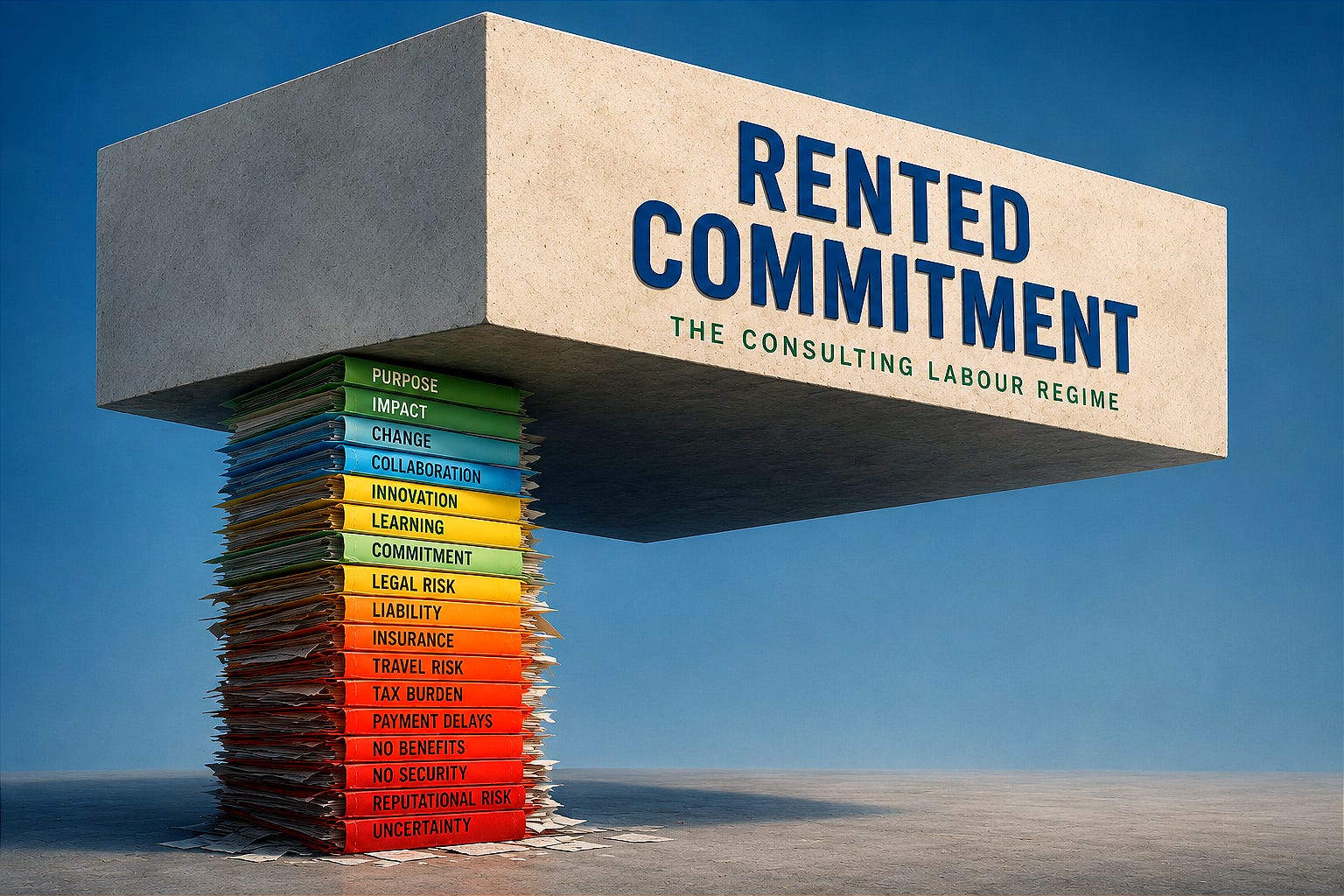
Consulting is usually described as a technical choice. Governments lack capacity, institutions need flexibility, projects require specialised and time-bound skills. The arrangement appears pragmatic, even efficient.
But consulting in global health is not just a staffing solution. It is a labour regime. And like all labour regimes, it reveals how power, risk, judgement and responsibility are distributed.
I write this from the inside. Over the years I have been hired as an external expert, consultant, technical adviser, senior evaluator and under various other titles that described essentially the same position: formally outside, functionally inside and always replaceable. The work has taken me to ministries, donor agencies and UN offices across several continents. I have written the reports, absorbed payment delays, inferred unspoken constraints and priced uncertainty into fees that, at times, never quite covered it.
I have also been relatively protected. I hold a passport that travels easily. I have access to networks many consultants lack. I have never faced the sovereignty asymmetries that national consultants navigate daily in their own countries. What follows is not a confession of victimhood. It is an attempt to name what the system does to the people it relies on, including those of us who have been comparatively fortunate.
Many choose consulting deliberately because it carries real advantages: autonomy, variety, exposure to different systems and some distance from institutional inertia. But choice means something different when alternatives are shrinking. Across global health, permanent positions have become harder to find while functions that look remarkably permanent are increasingly performed through serial short-term contracts. The consultant may be a free agent. But they are also a flexible worker in a system that has learned to outsource obligations while retaining control.
Over the past decades, consulting has moved from the margins of global health towards its centre. Entire programmes can now be designed, implemented, monitored and evaluated by people who sit formally outside the institutions they sustain. This shift is rarely discussed as a political or economic choice. It is framed instead as modernisation, efficiency, responsiveness or value for money.
Such language obscures what consulting actually does for the system.
At its core, consulting allows institutions to retain authority while externalising obligation. Consultants deliver outputs and absorb volatility, while decision-making power, budgetary control, institutional memory and organisational legitimacy stay firmly inside. The institution keeps continuity. The consultant carries uncertainty.
Contracts are short. Deliverables are tightly specified. Payment may be delayed, fragmented or contingent on approval processes outside the consultant’s control. Tax liabilities, legal exposure, travel risk, professional insurance and the securities institutions normally provide, like health coverage, disability protection or pension contributions, are individualised. The consultant is expected to price all of this into a daily rate. The institution gains flexibility. The consultant gains volatility. When projects fail, consultants are replaceable. When they succeed, success is institutionalised.
Management consultants command rates far above those working in health or development. The disparity is not explained by skill alone. It reflects what the system values. Consulting tied to capital is priced accordingly. Consulting tied to social goods is moralised, not monetised. There is an unspoken expectation that commitment to the mission should substitute for some compensation.
Independence remains real, but bounded by a specific form of precarity. This is not an accident. It is the point.
The same asymmetry appears in less obvious places. Consider the Terms of Reference, perhaps the defining document of consulting life. Tasks are listed, outputs defined, competencies enumerated. What is much harder to specify is the substantive judgement required to do the work.
Two equally qualified people may interpret the same brief very differently. One may see markets as part of the solution, another as part of the problem. One may understand equity as an instrument for improving outcomes, another as a political objective in its own right. One may see implementation failure as a technical problem, another as the predictable consequence of unequal power.
The assumption that expertise is interchangeable is convenient, and false. Institutions therefore select through proxies: prior clients, institutional affiliations, fluency in donor language and a reputation for being constructive. What is being selected is not agreement or insight, but legibility. Consultants are chosen because they sound recognisable to the system.
The result is a peculiar form of epistemic outsourcing. Institutions buy external judgement while retaining the authority to determine which forms of judgement are acceptable.
The asymmetry works in the other direction too. Terms of Reference are often deliberately broad. Is the consultant being hired to challenge an existing approach or legitimise it? Diagnose a political problem or optimise a technical response? The consultant learns to infer the answer indirectly: from who commissioned the work, where the funding comes from, which previous reports are cited and which subjects remain conspicuously absent.
This is political literacy, acquired informally and unevenly. Those who cannot read these cues may be disadvantaged regardless of the quality of their analysis. Those who can read them learn something else: how far an argument can travel before it stops being useful to the institution that commissioned it.
The contradiction becomes clearest when consultants move from writing documents to representing institutions. A consultant may arrive in a ministry carrying the expectations, vocabulary and apparent authority of a UN agency or donor. Government counterparts may reasonably assume that the person across the table speaks for that institution. Yet the consultant may have had no role in setting the policy, controlling the budget or defining the political relationship they are now expected to navigate. Formally independent, they temporarily embody an organisation to which they do not belong.
This is representational labour of a particularly exposed kind. Government counterparts may be more senior, more experienced and vested with sovereign authority. The consultant carries technical credibility, but no political mandate of their own. When such encounters go badly, the institution retains its mandate, relationships and continuity. The consultant carries the immediate reputational and contractual risk. Responsibility without protection. Visibility without control.
The exposure is not distributed equally. Some consultants are former institutional insiders who have left formal employment voluntarily. Others are precariously employed researchers, activists or clinicians who consult because their primary work does not provide sufficient income. Some are nationals of the countries where they work, navigating their own institutions with deep contextual knowledge but without the protective distance enjoyed by foreign contractors. Others arrive with passports, home-country health systems and university positions that make gaps between contracts easier to absorb.
Structural precarity is not universal. It is layered, and the layering follows familiar patterns of geography, citizenship, class and institutional affiliation.
Consulting is also one of the principal ways knowledge enters global health governance without necessarily disturbing its underlying arrangements. The consultant is almost perfectly suited to this function: knowledgeable, mobile, temporary and formally external. They can say things insiders may find harder to say. But there are limits. Structural problems are translated into technical recommendations. Political constraints become implementation barriers. Ambition is calibrated to feasibility. This is not because consultants lack ethics, courage or insight. It is because their livelihoods depend, at least partly, on remaining usable.
Consultants also live in project time. Contracts begin and end abruptly. Knowledge accumulated during one assignment may disappear when the contract closes. Relationships belong partly to individuals rather than organisations. Institutions speak continually about learning, yet a labour model built on temporary external expertise has weak mechanisms for keeping what has been learned. The paradox is that organisations externalise expertise partly to gain responsiveness, then sacrifice continuity in the process.
This model privileges those who can absorb uncertainty: people with financial buffers, strong passports, flexible family arrangements or alternative income streams. Those who need predictable income are filtered out quietly. Diversity initiatives may change who appears within projects while leaving untouched the labour conditions that determine who can afford to participate in the first place.
None of this means consulting is unnecessary. Complex organisations will always need specialised expertise that cannot sensibly be maintained permanently in-house. Many consultants do careful, principled and consequential work. Some institutions treat consultants well.
The issue is what happens when what was meant as an exception becomes an operating model. Consulting has become a solution to structural ambivalence: a way to act without fully committing, to expand capacity without expanding obligation, to draw on expertise without absorbing the people who provide it.
Understanding consulting as labour rather than service changes what becomes visible. The usual questions are about efficiency. Was the consultant qualified? Were the deliverables completed? A labour perspective asks different questions. Who carries the risk? Who owns the judgement? Who retains the relationships and institutional memory? Who absorbs the cost when contracts end or payments arrive late?
Above all, it asks why an arrangement that shifts so much uncertainty outwards has become so normal that it barely requires justification. Global health talks constantly about sustainability. Programmes should be sustainable. Financing should be sustainable. Health systems should be resilient. Countries should build durable capacity rather than depend indefinitely on external support.
It speaks much less about the sustainability of the labour on which its own programmes depend. Perhaps it should apply some of its favourite concepts closer to home.
A system increasingly dependent on temporary outsiders may be flexible. It may be responsive. It may sometimes even be efficient.
But if institutions keep the authority, continuity and protection while the people doing much of their work carry the uncertainty, we should at least be clear about what has been built.
Global health has not just hired consultants. It has learned how to rent commitment.
A thought-provoking piece.
I would add that when outsourcing becomes the default rather than the exception, it reflects more than administrative flexibility. It is 'adhocism institutionalised': a failure to build lasting capacity and, ultimately, an abdication of responsibility by those entrusted with it.
Institutions cannot indefinitely outsource their functions, rent expertise, and transfer risk while retaining authority and credit.
Expertise may be outsourced; institutional responsibility cannot.
Institutions hire consultants for independent expertise, but still decide which kinds of judgment they're willing to accept. And when speaking too freely might cost someone their next contract, how independent can that expertise really be? The question of sustainability seems just as relevant to the people doing the work as to the programmes themselves.